
When people talk about website security, the conversation often jumps straight to missing headers or whether a site has a Content Security Policy. Those checks still matter — but on their own, they rarely tell the most useful story.
In a small sample of 10 public website scans, the more meaningful findings weren't the usual checklist items. The stronger signals came from publicly reachable high-risk paths, outdated frontend dependency indicators, and incomplete email trust controls that could make it easier for bad actors to impersonate a business.
Publicly reachable high-risk paths are still showing up
One of the more concerning patterns in the sample was the presence of publicly reachable paths associated with sensitive or internal files — things like:
- Environment files (
.env) - Version-control artifacts (
.git,.svn) - Development leftovers
- System-generated metadata (
.DS_Store)
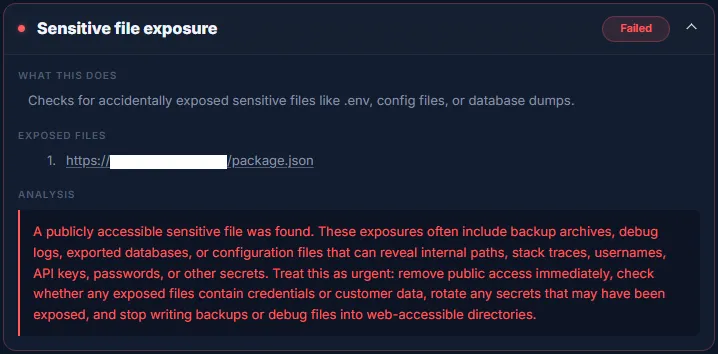
That doesn't always mean a website is actively leaking production secrets. Some sites return fallback content or generic HTML on unexpected paths. But when high-risk paths appear publicly reachable at all, they raise a legitimate information-disclosure concern.
From an attacker's perspective, this kind of signal is useful because it may reveal traces of the development stack, evidence of incomplete deployment cleanup, or clues about frameworks, workflows, and hosting conventions. Even partial or indirect exposure can make reconnaissance meaningfully easier.
Outdated frontend dependency signals can reveal security debt
In a smaller number of scans, results surfaced indicators associated with outdated jQuery assets and known jQuery-related CVEs. That doesn't automatically prove an exploitable condition on the live site — but it does suggest that publicly visible frontend dependencies may not be keeping pace with current security expectations.
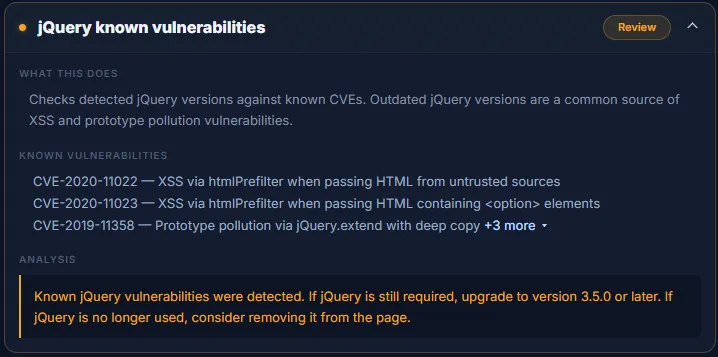
This matters for two reasons.
First, old dependency signals tell an attacker where to look next. Public clues about outdated libraries help narrow targeting and reduce guesswork.
Second, they often point to a broader maintenance issue. If a business-critical website is still serving old frontend components, the risk isn't limited to one library. It may reflect patching delays, stale assets, or weak dependency-review processes across the entire stack.
The value of this finding isn't just the library name — it's what that version implies about overall security hygiene.
Email security gaps increase impersonation risk
The sample also showed recurring gaps in email-related trust controls, including issues involving SPF, DMARC, MTA-STS, and related protections.
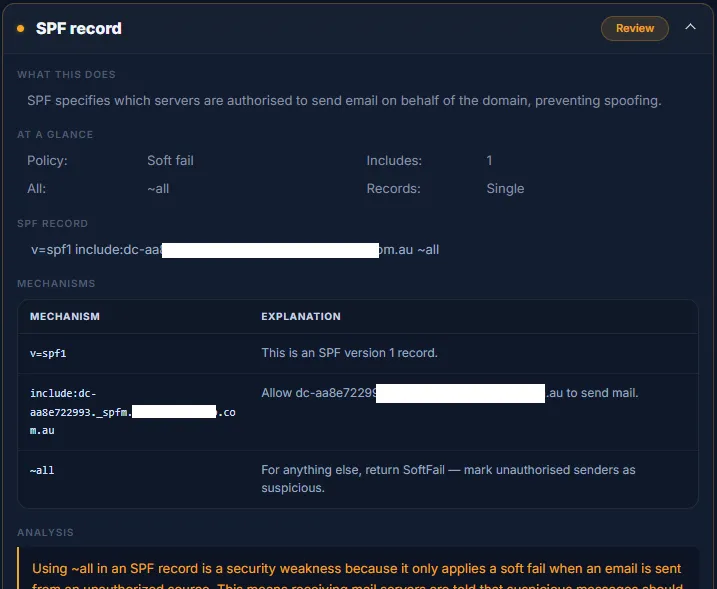
These findings deserve careful framing.
They do not necessarily mean an attacker can break into a website or compromise an internal system. But they do mean it may be easier for bad actors to impersonate a business in email communications — creating problems such as:
- Phishing messages that appear more believable
- Fraudulent customer outreach
- Fake invoice or payment-related communications
- Brand trust erosion and downstream risk for customers and partners
For many businesses, that kind of abuse can be just as damaging as a technical flaw on the site itself. A public website doesn't exist in isolation. It's part of a broader trust surface that includes domains, email, customer communications, and brand reputation. When those controls are weak, attackers may not need to "hack the site" in any narrow sense to cause real harm.
Third-party resources add quiet exposure
A recurring theme was reliance on third-party scripts without strong visible integrity controls.
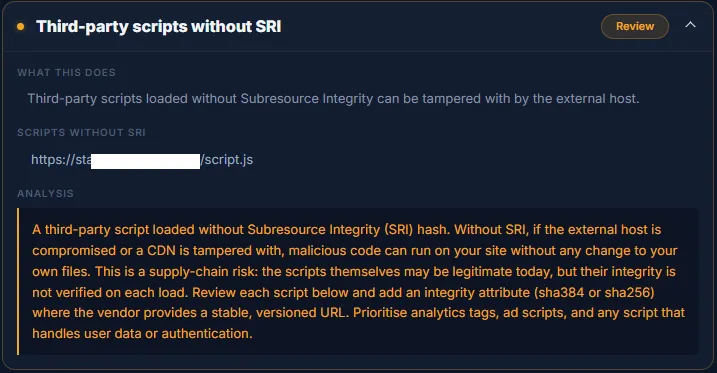
This is easy to overlook because modern websites routinely pull in external code for analytics, tag management, chat functions, embeds, and marketing tools — and those integrations accumulate over time. The security risk isn't simply that a site uses third-party code. The issue is that each external dependency expands the public attack surface and may not be reviewed regularly after implementation.
A website can appear modern and professionally maintained while still carrying unnecessary external exposure behind the scenes.
Missing hardening controls are common — but they're not the whole story
Yes, missing browser-facing hardening controls showed up frequently. That included common gaps around security headers and policy-related protections. But those findings need context.
If many public websites are missing a control like CSP, that doesn't automatically make every instance a headline-level issue. Many organizations — including large ones — still operate without fully mature browser hardening policies.
That's exactly why these items should be read as part of a broader posture review, not treated in isolation. In this sample, missing headers were often less compelling than the more practical issues: high-risk path exposure, stale dependency signals, and email trust gaps that could be abused for impersonation.
What this suggests in practice
The most useful public website findings aren't always the most obvious checklist items.
In this sample, the more meaningful signals came from three areas:
- Publicly reachable high-risk paths — exposing things that shouldn't be externally reachable
- Outdated frontend dependency indicators — visible signs of maintenance neglect
- Incomplete email trust controls — leaving the domain open to impersonation
These findings help move the conversation away from generic best-practice checklists and toward operational risk. They answer better questions:
- Is this website exposing things that should not be externally reachable?
- Are visible dependencies showing signs of neglect?
- Could weak domain and email controls make the business easier to impersonate?
- Is the website's trust surface broader and weaker than it appears?
That's where a public scan becomes valuable — not because it proves a breach path on its own, but because it helps identify where deeper review and remediation are most likely to matter.
Final thought
A website can look polished, load quickly, and still reveal more than a business expects.
The signal might come from exposed paths that shouldn't be reachable, aging frontend components, or email controls that leave more room for impersonation than a brand would want. None of these is necessarily catastrophic in isolation. But together, they show where quiet, real-world exposure is starting to accumulate.
If your team wants a clearer view of what your website may already be revealing from the outside, a public-facing scan is a practical first step — and often a faster way to prioritise what actually deserves closer attention.