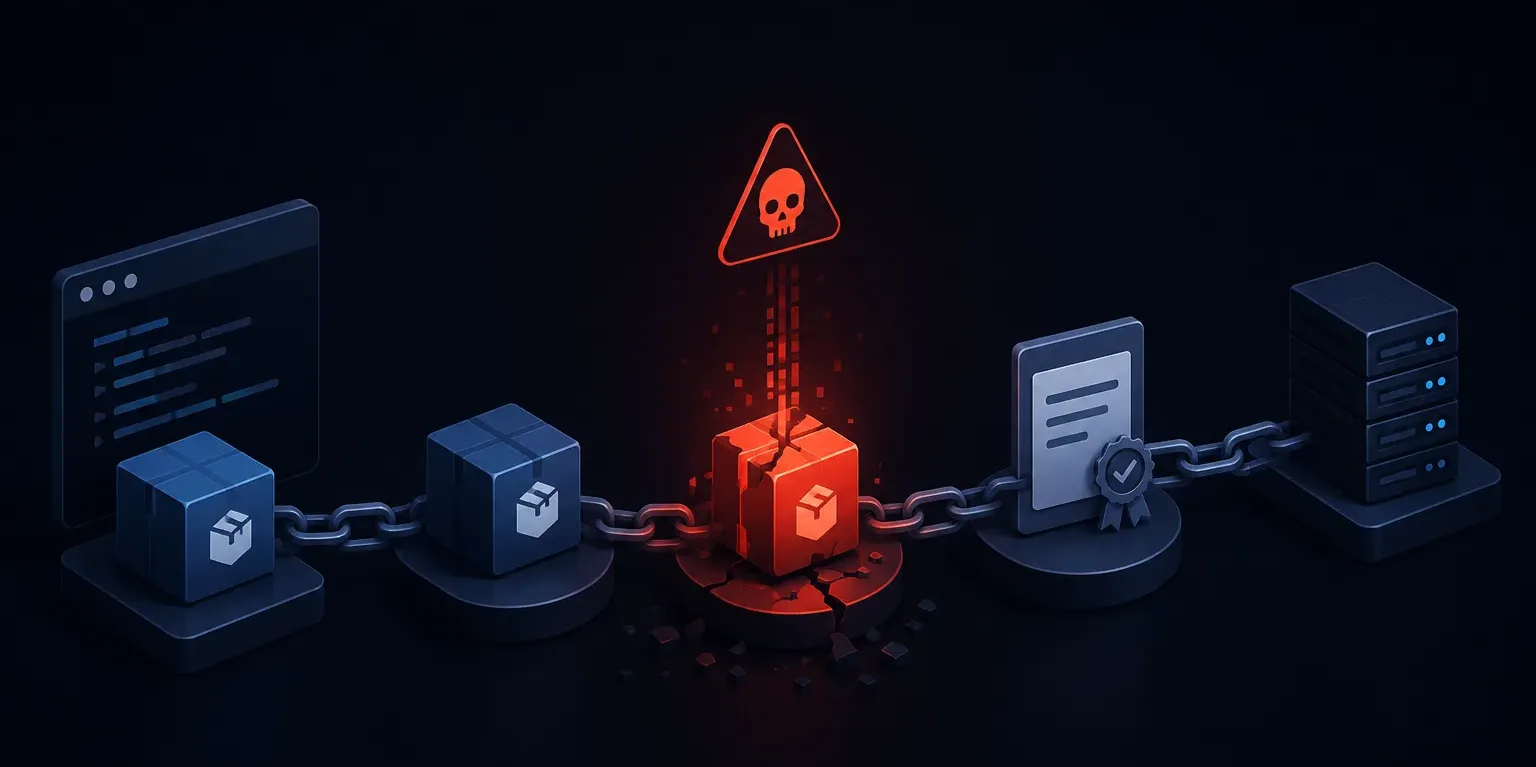
"We audited our own code. Our dependencies are someone else's problem." — Until they become yours.
Spring 2026 was a turning point for supply chain attacks. Within a matter of weeks, a trojanized software installer hit thousands of machines across 100+ countries, a certificate authority was breached via a malicious file sent through a customer support channel — resulting in fraudulent code-signing certificates used to distribute real malware — and a popular open-source framework compromise reached inside one of the world's most prominent AI companies.
These weren't exotic zero-days. They were trust exploits — attacks that abuse the relationships between your organisation and the tools, libraries, and vendors you've already approved.
If you're running a software team, an ecommerce platform, or any business that depends on third-party code, this post is about why your clean vulnerability scan report might be hiding the biggest risk on your network.
What Happened: Three Incidents, One Pattern
1. DAEMON Tools — Trojanized Installers (May 6)
A supply-chain attack compromised the official installer distribution of DAEMON Tools, a widely used disc utility. The trojanized packages delivered malware to thousands of users across more than 100 countries.
What made it effective: - Users downloaded from what appeared to be the legitimate source - The installer carried a valid-looking digital signature - Antivirus engines initially trusted the binary because of its origin - The malware established persistence before most users noticed anything unusual
The lesson: Your users trust your download page. If an attacker compromises your build or distribution pipeline, that trust becomes the attack vector.
2. DigiCert — Fraudulent Code-Signing Certificates (Disclosed May 4)
On April 2, 2026, a threat actor posed as a customer on DigiCert's support chat and delivered a malicious ZIP file disguised as a screenshot. The file contained a .scr executable that infected an analyst's endpoint — one where CrowdStrike protections had been configured below the required standard. From that foothold, the attacker pivoted to DigiCert's internal support portal and obtained initialisation codes for already-approved EV Code Signing certificate orders. Those codes were enough to retrieve 60 certificates across multiple accounts.
At least 27 of those certificates were directly linked to the attacker's activity, and 11 were confirmed by external researchers to have been used to sign payloads from the Zhong Stealer malware family — a credential and cryptocurrency-stealing tool linked to the China-based threat group GoldenEyeDog. All identified certificates were revoked by April 17; the breach was publicly disclosed on May 4.
What made it dangerous:
- Code-signed malware bypasses SmartScreen, Gatekeeper, and most endpoint protection heuristics
- The certificates were issued by a trusted CA — the chain of trust was intact from the OS perspective
- Victims had no reason to suspect the signed binary was malicious; it carried the trust of a major certificate authority
- A secondary incident followed: Microsoft Defender incorrectly flagged legitimate DigiCert root certificates as malware (Trojan:Win32/Cerdigent.A!dha), causing widespread enterprise disruption until the detection signature was corrected
The lesson: Even your WAF won't help here. When trust infrastructure itself is compromised, your entire verification model breaks down. And the support portal — designed to help customers — became the key to the kingdom.
3. Mini Shai-Hulud / TanStack → OpenAI (May 11–15)
On May 11, 2026, between 7:20 and 7:26 p.m. UTC — a window of six minutes — the threat group TeamPCP published 84 malicious versions of 42 npm packages from the TanStack namespace to the public registry. This was part of a broader campaign called "Mini Shai-Hulud," which ultimately compromised over 170 npm and PyPI packages spanning high-profile namespaces including Mistral AI, UiPath, Guardrails AI, and OpenSearch. The malware was worm-like: it propagated by stealing CI/CD credentials and using them to compromise further packages through legitimate workflows.
OpenAI was one of the downstream casualties. Two employee devices in the corporate environment were infected, and limited credential material was exfiltrated from internal source code repositories those employees had access to — including code-signing certificates for iOS, macOS, Windows, and Android products. OpenAI rotated all affected certificates and required all macOS users to update their applications by June 12, 2026. No customer data, production systems, or product code was affected.
What made it significant: - TanStack packages collectively receive tens of millions of weekly downloads — the blast radius of a single compromise is enormous - The attack was worm-like: stolen CI/CD credentials propagated the compromise across dozens of unrelated projects automatically - The campaign reached a high-profile target through the dependency chain, not through any vulnerability in OpenAI's own code - Even with rapid response, code-signing certificates were exposed, forcing a disruptive certificate rotation affecting all platform users
The lesson: You don't just trust your direct dependencies. You trust their dependencies, their CI pipelines, and the credentials those pipelines use. The attack surface is recursive — and it self-propagates.
The Anatomy of a Supply Chain Attack
Supply chain attacks follow a predictable pattern. Understanding it helps you defend against it:
- Compromise a trusted upstream — package registry, CA, build server, or vendor
- Inject malicious payload — trojanized update, backdoor, or signed malware
- Legitimate distribution channel delivers it — npm install, auto-update, official download
- Downstream consumers trust and execute — CI/CD pipelines, developer machines, production servers
- Attacker gains access, credentials, or persistence — the damage is done before anyone notices
Unlike a direct attack on your application, you may never see the initial vector. The malicious code arrives through a channel you've already whitelisted.
Why Traditional Security Testing Misses This
Most security programmes focus on what you can control directly: your code, your infrastructure, your configurations. That's necessary but insufficient.
Here's what typical testing covers vs. what supply chain attacks exploit:
| What You Test | What Supply Chain Attacks Target |
|---|---|
| Your application code | Your dependencies' code |
| Your network perimeter | Your build pipeline |
| Your servers | Your developers' machines |
| Your WAF rules | Your certificate trust chain |
| Your access controls | Your vendors' access controls |
| Your vulnerability scan | Transitive dependencies you've never reviewed |
This is why a clean scan report can be misleading. Your code can be flawless while the library it imports is silently exfiltrating environment variables.
Real-World Attack Surface: What We Find During Pentests
When we conduct supply chain-focused assessments, we consistently find the same categories of exposure:
Dependency Confusion & Typosquatting
# Checking for internal package names that could be claimed on public registries
npm config list --json | grep registry
pip config list 2>/dev/null | grep index-url

# Common finding: internal package names that are
# not reserved on npm/PyPI — anyone could register them
Many organisations publish internal packages with names that are available on public registries. An attacker can upload a malicious package with the same name but a higher version number — and npm install or pip install may pull the attacker's version.
Exposed CI/CD Credentials
# What we look for in accessible CI configurations
# Common findings: plaintext tokens, overly broad IAM roles,
# secrets in environment variables visible to any build step

# Example: GitHub Actions workflow with broad permissions
grep -r "AWS_ACCESS_KEY_ID\|NPM_TOKEN\|DOCKER_PASSWORD" .github/workflows/

# The risk: any dependency that runs a postinstall script
# can read these environment variables
A compromised dependency running as a postinstall script has access to every environment variable in your CI pipeline — including deployment keys, registry tokens, and cloud credentials. This is exactly how Mini Shai-Hulud self-propagated: stolen tokens used to poison further packages through legitimate publish workflows.
Unsigned or Unpinned Dependencies
// Dangerous: floating version ranges
{
  "dependencies": {
    "tanstack-react-table": "^8.x"
  }
}

// Better: pinned versions with integrity hashes
{
  "dependencies": {
    "tanstack-react-table": "8.20.5"
  }
}
// With package-lock.json integrity field verified
Without integrity checking, a compromised registry can serve different code to different consumers — targeted supply chain attacks that are nearly impossible to detect through casual inspection. If your lockfile had pinned versions with hashes on May 11, the TanStack attack would have had no effect on your build.
Build Pipeline Integrity
The DAEMON Tools incident is a textbook example. We routinely find:
- Build servers with internet access and no egress filtering
- Signing keys stored on the same machine that runs builds
- No reproducible build verification — nobody checks that source matches binary
- Deployment pipelines that auto-publish without human review
How the Nightmare-Eclipse Campaign Changes the Equation
While you're thinking about supply chain risk, there's a parallel threat worth noting. The Nightmare-Eclipse campaign (disclosed in May 2026) has been actively exploiting Windows Defender and BitLocker vulnerabilities — including several that remain unpatched.
The connection to supply chain risk is direct: if your developers' machines are running Windows with compromised Defender protections (the "UnDefend" exploit blinds Defender while the system appears healthy), any code they push, any credential they use, and any build they run is potentially tainted.
The attack chain converges:
- Compromise a developer's machine via Nightmare-Eclipse
- Use their legitimate credentials to push malicious code
- The code passes through your CI/CD pipeline with valid signatures
- Your supply chain is now poisoned — from the inside
This is why endpoint security and supply chain security are not separate problems.
Actionable Steps for Software Teams
Immediate (This Week)
-
Audit your dependency tree — Run
npm audit,pip-audit, or your ecosystem's equivalent. But more importantly: do you know what your dependencies' dependencies are doing? -
Pin and verify — Lock dependency versions and enable integrity checking. In npm, ensure
package-lock.jsonintegrity fields are present. In Python, use hash-checking mode:bash pip install --require-hashes -r requirements.txt -
Check for dependency confusion — Are any of your internal package names available on public registries? If so, either reserve them or configure scoped registries.
Short-Term (This Month)
-
Audit CI/CD secrets — Which environment variables are exposed to build steps? Could a
postinstallscript read your deployment keys? Scope permissions to the minimum required. Mini Shai-Hulud spread precisely because stolen publish tokens had too much access. -
Review third-party access — What access do your vendors, contractors, and SaaS tools have to your systems? The DigiCert incident started with a support chat message. The M&S breach started with a help desk call. The support channel is consistently the weakest link.
-
Enable SBOM generation — Start producing Software Bills of Materials for your builds. You can't assess risk in dependencies you can't enumerate.
Strategic (Ongoing)
-
Include supply chain in your pentest scope — Standard application pentests rarely cover dependency risk, build pipeline security, or developer workstation exposure. Ask your provider specifically about supply chain testing.
-
Implement SLSA or equivalent build attestation — The SLSA framework (Supply-chain Levels for Software Artifacts) provides a structured approach to build integrity verification.
-
Monitor for anomalous dependency behaviour — Tools like Socket (for npm) can detect when packages make unexpected network calls, access the filesystem outside their scope, or introduce new permissions. Socket flagged Mini Shai-Hulud packages within hours of publication.
The Bottom Line
Your organisation's security perimeter no longer ends at your firewall — or your codebase. It extends through every package you install, every vendor you trust, every certificate you validate, and every build pipeline you run.
The spring 2026 incidents demonstrated that attackers have shifted their focus from breaching your defences to poisoning your supply chain — and that self-propagating worms can turn a single compromised package into a hundred within hours. The question isn't whether you'll be affected. It's whether you'll detect it before the damage is done.
If you're unsure where your supply chain exposure starts, that's exactly what a penetration test is designed to reveal — not just in your code, but in the trust relationships your code depends on.
Want to understand your real exposure? Request a free security snapshot and we'll show you what's visible from the outside — including the dependencies and services you might not have considered.
Source Notes
- Barracuda — Nightmare-Eclipse: six zero-days, six weeks and one big grudge
- Cyber Management Alliance — Biggest Cyber Attacks, Data Breaches, Ransomware Attacks of May 2026
- BlackFog — The State of Ransomware 2026
- Wiz Research — CVE-2026-3854: GitHub Git Push RCE via Internal Trust Boundary Abuse
- CISA — Known Exploited Vulnerabilities Catalog