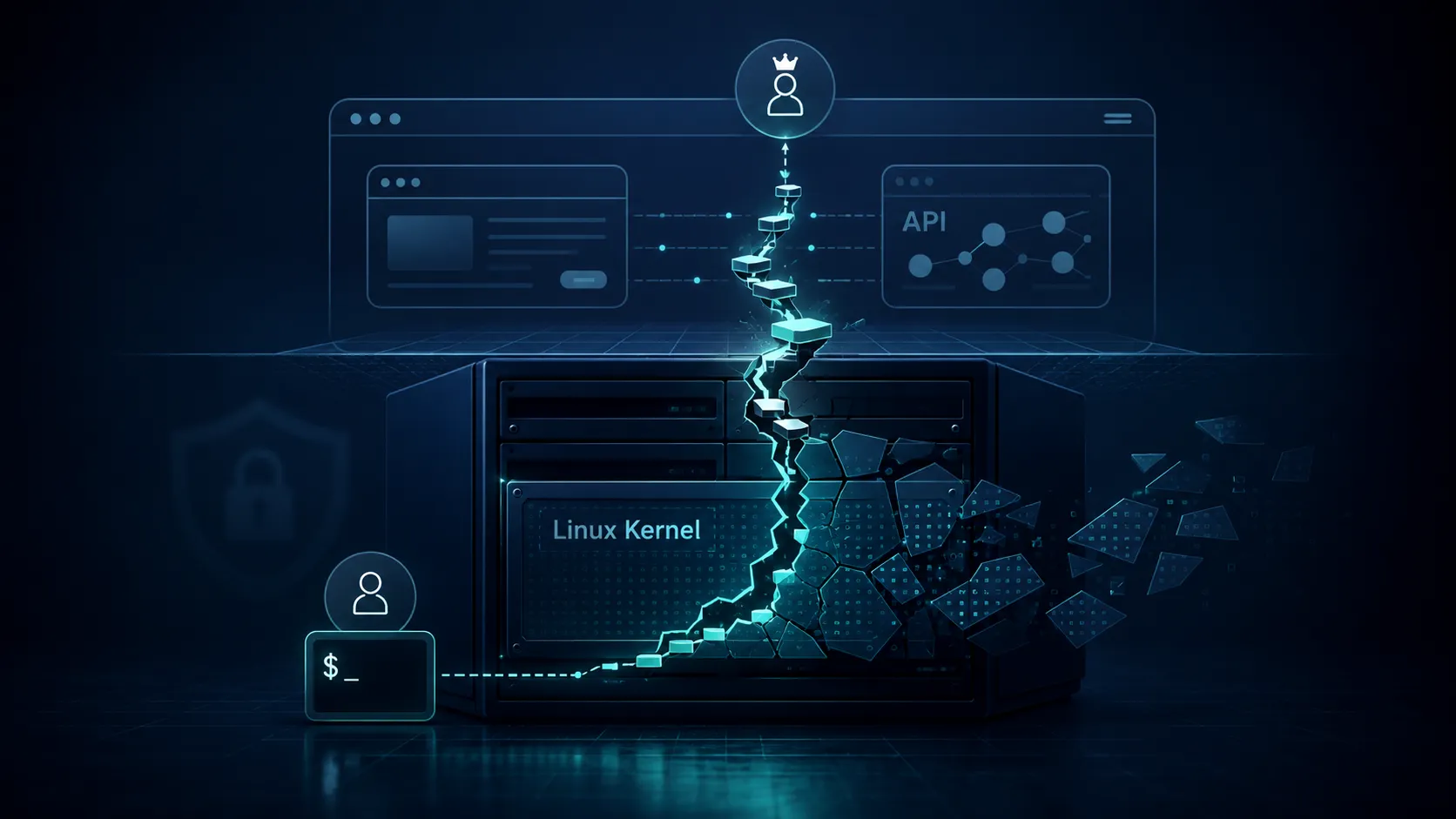
When a new Linux kernel vulnerability surfaces, the immediate question from web teams is usually the same: does this affect us? For Dirty Frag, the honest answer is: not directly — but potentially, yes. Here is why that distinction matters.
Dirty Frag is not "just a Linux problem"
Dirty Frag is a recently disclosed Linux kernel local privilege escalation vulnerability class. It affects kernel networking and crypto paths associated with IPsec ESP and RxRPC, and public proof-of-concept exploit code has been released.
At first glance, it may look like an infrastructure-only issue:
- It is a Linux kernel vulnerability.
- It requires local code execution or a local user account.
- It is not, by itself, a remote unauthenticated web application exploit.
That last point is important. Dirty Frag does not mean that every website can be remotely taken over just because it runs on Linux.
But dismissing it as "only local" would be a mistake.
For web applications, ecommerce platforms, CI systems, container hosts, and shared servers, local privilege escalation is often the second step in a real attack chain. If an attacker can first gain limited code execution through a vulnerable plugin, exposed admin panel, leaked credential, unsafe upload flow, compromised build job, or weak container boundary, a kernel local privilege escalation can turn that foothold into root access.
That is why Dirty Frag matters. Not because it starts every attack. Because it can finish one.
What is Dirty Frag?
Dirty Frag is the name given to a pair of Linux kernel page-cache write vulnerabilities disclosed by security researcher Hyunwoo Kim (also known as V4bel). The issue is commonly discussed as a chain involving two components:
- xfrm-ESP Page-Cache Write — affects Linux kernel paths related to IPsec ESP, including the
esp4andesp6modules. Several advisories track this as CVE-2026-43284. - RxRPC Page-Cache Write — affects the
rxrpcmodule, associated with RxRPC and AFS-related functionality. Several sources track this as CVE-2026-43500, though CVE and patch status may vary between advisories and distributions.
The technical mechanics are complex, but the high-level idea is straightforward:
- An attacker can arrange for a page-cache-backed file page to be referenced through kernel networking buffers.
- Vulnerable kernel crypto paths then perform in-place writes on memory that should not be writable from the attacker's perspective.
- The attacker can influence in-memory file contents observed by later reads or executions.
- When chained successfully, this can lead to root privileges.
Dirty Frag belongs to the same broad family of "dirty" Linux bugs as Dirty Pipe: bugs where data that should be treated as read-only can be modified through unintended kernel behaviour.
The key operational takeaway is this:
> Dirty Frag is a local privilege escalation issue with public exploit code. If an attacker already has a way to run code locally, the risk can escalate very quickly.
Local does not mean low risk
Security teams sometimes treat local privilege escalation as less urgent than remote code execution. That instinct is understandable — remote unauthenticated vulnerabilities can be exploited from the internet without any prior access. But modern attacks are rarely single-step events.
A typical compromise may look like this:
- An attacker finds a vulnerable web plugin, outdated dependency, exposed upload handler, weak admin password, leaked API key, or misconfigured CI job.
- They gain limited code execution as a low-privilege user —
www-data,nginx,apache, a build user, or a containerised workload. - They use a local privilege escalation bug to become root.
- They disable security tools, read secrets, access databases, modify application code, install persistence, or pivot deeper into the environment.
In that chain, Dirty Frag is not the front door. It is the staircase from a limited foothold to full control.
That distinction matters for web application owners. A web vulnerability that "only" gives limited server-side execution can become significantly more damaging if the underlying host also carries an exploitable kernel privilege escalation path.
Where Dirty Frag is most concerning
Dirty Frag should be prioritised based on where untrusted or semi-trusted code can run.
1. Shared hosting and multi-tenant servers
Any environment where multiple users, customers, websites, or workloads share the same Linux host deserves attention. If one tenant gains local code execution, a kernel local privilege escalation may threaten isolation between tenants and the host.
2. Ecommerce and CMS platforms
A vulnerable extension, abandoned plugin, unsafe file upload, stolen admin credential, or webshell can give an attacker a low-privilege foothold. From there, Dirty Frag-style privilege escalation can turn application compromise into full server compromise.
This is especially relevant for platforms that rely heavily on third-party plugins, themes, payment modules, shipping integrations, or admin-side extensions.
3. CI/CD runners and build hosts
CI systems execute code from branches, pull requests, build scripts, test harnesses, package managers, and deployment automation. If a runner is not properly isolated, a local privilege escalation can become a route from build execution to host-level compromise — exposing signing keys, deployment credentials, cloud tokens, container registry credentials, and production secrets.
4. Container hosts and Kubernetes nodes
Dirty Frag is not automatically a container escape in every configuration. But container hosts should still treat local kernel privilege escalation seriously, particularly where workloads are untrusted or carry excessive privileges.
Risk increases significantly when containers use broad capabilities, weak seccomp/AppArmor/SELinux profiles, host mounts, privileged mode, or other patterns that reduce isolation.
5. Developer and staging servers
Staging environments often have weaker controls than production, yet still contain real credentials, deployment paths, test data, and internal access. An attacker who gains code execution on a staging Linux server may use local privilege escalation to collect secrets that later affect production.
Why earlier mitigations may not be enough
Dirty Frag is closely related to prior "dirty" kernel bugs, but it should not be treated as fully solved just because previous mitigations were applied. The research describes overlapping but distinct kernel paths — specifically, Dirty Frag can use paths through xfrm/IPsec ESP and RxRPC rather than relying on the same module or mitigation target as earlier vulnerabilities.
Do not assume that a previous emergency mitigation automatically covers Dirty Frag. The safer approach is to check current vendor guidance for the exact distribution and kernel version in use.
What administrators should do
1. Check your distribution advisory
Review guidance from the vendor or distribution that provides your kernel. Ubuntu, Red Hat, AlmaLinux, AWS, CloudLinux, and others have published or are publishing updates and mitigations. Do not rely only on upstream kernel status — many production systems run distribution kernels with backported patches.
2. Patch and reboot
Once a fixed kernel package is available for your distribution, install it and reboot into the fixed kernel. Confirm the running kernel version after reboot. A kernel update does not protect a running system until the fixed kernel is actually loaded.
3. Consider temporary module blocking where safe
Several advisories recommend blocking or unloading affected modules:
esp4esp6rxrpc
This can reduce exposure while waiting for patched kernels. However, note the trade-offs: disabling esp4 and esp6 may break IPsec ESP VPNs, and disabling rxrpc may affect environments using RxRPC or AFS-related functionality. Do not apply module blocking without first confirming those modules are not required.
4. Reduce local execution paths
Because Dirty Frag requires local code execution or local access, reducing the paths to local execution is part of the mitigation strategy. Practical controls include:
- Remove unnecessary shell access and harden SSH.
- Keep web applications, plugins, and dependencies patched.
- Restrict file upload execution paths.
- Isolate CI runners from host resources and secrets.
- Avoid running untrusted workloads on shared hosts.
- Use SELinux, AppArmor, and seccomp where appropriate.
- Avoid privileged containers unless absolutely necessary.
- Review user namespace and container capability settings.
5. Monitor for suspicious escalation behaviour
Detection should focus on signs that limited execution is turning into privileged execution:
- Unexpected root shells or unusual setuid binary execution.
- Suspicious changes in process ancestry.
- Unexpected kernel module loading.
- Web server users spawning shells or system tools.
- CI jobs accessing host-level secrets.
- Security tooling being disabled or tampered with.
Dirty Frag-style bugs may modify page-cache state rather than writing obvious files to disk, so detection should not rely solely on traditional file integrity checks.
What this means for web application security reviews
Dirty Frag is a useful reminder that web application security cannot stop at the HTTP layer.
A scanner may identify missing headers, outdated JavaScript libraries, exposed admin panels, or known CVEs. Those findings matter. But real risk often depends on how weaknesses combine:
- A file upload bug is more serious if uploaded code can execute on a vulnerable Linux host.
- A low-privilege webshell is more serious if the kernel has a public local privilege escalation exploit.
- A CI misconfiguration is more serious if the runner shares a host with secrets and privileged workloads.
- A container escape concern is more serious if the node kernel is exposed to a known LPE chain.
A useful security review asks:
- Can an attacker get any form of code execution?
- What user would that code run as?
- What secrets can that user access?
- Can that user reach local kernel attack surface?
- Are containers, CI runners, and build agents properly isolated?
- Are kernel patches installed and rebooted into?
- Are emergency mitigations compatible with business-critical services such as VPNs?
Dirty Frag is not only a kernel story. It is an attack-path story.
Quick reference checklist
For teams running Linux servers — web apps, APIs, ecommerce, containers, or CI/CD:
- [ ] Inventory affected hosts — internet-facing servers, container hosts, CI runners, shared systems, staging servers, and developer boxes.
- [ ] Check your distribution advisory — use your vendor's advisory, not just the upstream kernel version.
- [ ] Patch and reboot — kernel fixes require a reboot into the updated kernel to take effect.
- [ ] Assess module blocking — evaluate whether blocking
esp4,esp6, andrxrpcis safe in your environment (check for IPsec VPN or AFS/RxRPC dependencies first). - [ ] Reduce local execution paths — patch plugins, CMS components, upload handlers, and CI workflows that could hand an attacker a foothold.
- [ ] Harden containers and runners — restrict privileged containers, capabilities, host mounts, and weak isolation patterns.
- [ ] Monitor escalation behaviour — watch for low-privilege users spawning shells, unexpected setuid activity, unusual root processes, and security tooling changes.
Final thought
Dirty Frag should not be exaggerated into "every Linux website is remotely exploitable." That would be inaccurate. But it should not be dismissed because it is local, either.
For many real-world attacks, local privilege escalation is the step that turns a contained incident into a full server compromise. If a web application, plugin, CI runner, or container workload gives an attacker the first foothold, Dirty Frag can make the second step far more dangerous.
The lesson is straightforward:
- Do not evaluate vulnerabilities in isolation. Evaluate the attack path.
That is where the real risk usually lives.
Sources
- Ubuntu — Dirty Frag Linux kernel local privilege escalation vulnerability mitigations
- AlmaLinux — Dirty Frag vulnerability fix is ready for testing
- Red Hat — RHSB-2026-003 Networking subsystem Privilege Escalation — Linux Kernel Dirty Frag
- AWS Security Bulletin 2026-027-AWS — Dirty Frag and other issues in Amazon Linux kernels
- Sansec — Linux DirtyFrag kernel vulnerability
- Help Net Security — Dirty Frag: Unpatched Linux vulnerability delivers root access
Not sure what your public-facing security exposure looks like?
Apply for a Free WardenBit Security Snapshot. We review selected websites, web apps, APIs, and ecommerce stores for visible external risk signals and practical next steps - no admin access, passwords, or secrets required.